
When people hear the words digital painting, misunderstandings come quickly, far too quickly. So do the prejudices. Some imagine software that transforms a photo into a painting with a single click. Others think of images generated by artificial intelligence, those visuals that have flooded social feeds over the past few years. And others still picture vector illustrations with perfect outlines and clean flat colors.
None of those images have anything to do with what I do.
Digital oil painting, as I practice it, is a fully-fledged pictorial discipline. It requires the same knowledge as classical painting: understanding light, mastering values, building a composition, working with color and texture. The only difference lies in the working surface: a graphics tablet rather than a canvas, software rather than pigments mixed with oil. And this work is measured in hours… Many hours.
I am Alexandra Dubois, known as Blue, a digital painter and the founder of Graph’Art Studio. Trained in graphic design, introduced to traditional painting before finding my path in digital, I am in a rather particular position to answer this question. I know both shores. So I will talk to you about it as I live it, with my tablet in hand rather than a dictionary on my lap… What digital painting really is, what it is not, how I work with it, and why it chose me as much as I chose it.
What Digital Painting Really Is
A Living Medium
Digital painting is often reduced to its support: software, a screen… rather than being defined by what it actually does. That is a mistake in perspective.
Digital oil painting is a pictorial discipline that applies the same rules as traditional painting: light, values, composition and texture, through creative software like Photoshop and a graphics tablet. It requires the same level of technical mastery and the same investment of time as painting on canvas. What changes is the surface. Not the nature of the work.
What also sets digital painting apart is what it shares with traditional oil painting: working in layers. In Photoshop, I build an image the way one applies glazes on a canvas, accumulating light layers of information that transparency gradually reveals. Light is sculpted rather than placed. Color is built rather than chosen.
It is a living medium. Not an automatic result.
What It Is Not
Three confusions come up regularly, and it is worth addressing them clearly.
Digital painting has nothing to do with generative artificial intelligence. Images produced by Midjourney, DALL·E or Stable Diffusion are generated by algorithms trained on millions of existing images. Some artists have made this tool an approach in its own right, recognized and sometimes remarkable. But it is not mine. In my practice, every aesthetic decision is built by hand, with a stylus, in a process that nothing automates.
Digital painting should not be confused with photo retouching either. Retouching a photograph means modifying something that already exists. Painting digitally means building an image through intention and gesture, on a blank surface.
Commercial illustration sometimes shares the same tools, but operates on a different logic. Illustration serves a brief, a format, a message. Painting responds to an artistic intention. Not a hierarchy. A difference in nature.
A Few Historical Milestones
Digital painting is often associated with something recent, almost fleeting. Yet it is rooted in several decades of artistic and technical history.
As early as the 1980s, professional systems such as the Quantel Paintbox, designed in the United Kingdom, already made it possible to paint on screen in television studios. These machines cost a fortune and remained reserved for a handful of insiders, but the gesture was already there, a stylus on a pressure-sensitive surface, an image born from the hand.
In 1990, Adobe launched the first version of Photoshop, developed a few years earlier by brothers Thomas and John Knoll. This software, initially designed for professional photo retouching, quickly became the reference studio for thousands of artists around the world. That same decade saw Wacom’s professional graphics tablets, whose origins date back to 1983 in Japan, become established in creative studios (source: Wacom Company History, 2023; Adobe, Photoshop History, 2024).
But the legitimization of digital painting as a serious artistic practice owes much to an unexpected artist: David Hockney. As early as 2009 on iPhone, then on iPad from 2010, the British painter created works that were entirely digital. In 2012, the Royal Academy of Arts in London dedicated a major exhibition to him, “A Bigger Picture,” presenting his digital landscapes alongside drawings and paintings on paper. For many, this was the moment when digital painting gained new visibility in the conversation of contemporary art (source: Royal Academy of Arts, David Hockney RA: A Bigger Picture, 2012).
What Hockney showed is that the medium does not define the legitimacy of a work. What matters is intention, sensibility, mastery of vision. Digital painting did not wait to be recognized to be serious. It always was, for those who truly practiced it.
Where I Come From, and How I Got Here
Traditional Painting, a Freedom to Earn
Before digital, I painted, I drew. On canvas, on paper, with watercolor, acrylic, oil paint, pastel, charcoal. Creation has always been part of my life, in different forms and at different intensities. And in each of these practices, I kept running up against something.
When you paint with oil on canvas and a section is not working, it all depends on the moment. While the paint is still fresh, you can still wipe it away, rework it. But once it has dried, the doors close. Try to paint over it, hoping the layers will hold. Scrape it down, risking damage to what was working nearby. Start over entirely, sometimes. Days, weeks of work disappearing because a single detail refused to cooperate.
I am deeply perfectionist. This constant relationship with risk, the fear of ruining something irreparable, compounded by very real practical constraints: the cost of materials, the drying times that imposed rhythms I had not chosen, the physical space all of it required. So many frictions between what I had in my head and what I could actually achieve on the canvas.
When Life Reinvents the Way of Creating
Something else happened too. At a certain point, creating the way I used to was not simply difficult: it was impossible. Life sometimes forces you to completely reinvent the way you work. And when creating is the only thing keeping you upright, you adapt. You find another path. Not as a fallback, but out of profound necessity.
Digital painting offered me something that traditional painting could no longer offer in those moments. The possibility of working anywhere, without bulky materials, without drying constraints, with the same standard of results. It was in this context that I began to explore it seriously. Not as a plan B. As a door opening at the right moment.
The Breakthrough
I was a graphic designer. The world of software was not foreign to me. But moving to digital oil painting was something different from mastering a tool. It was discovering that what I had been searching for all along had a name, and an address.
That day, I understood that this technique finally allowed me to do exactly what I had in my head. No more limitations tied to drying time, to impossible corrections, to the fear of losing everything because a single detail was off.
In Photoshop, a painting is built in layers, like glazes being deposited and gradually revealed. And when something is off: a gaze that does not fall quite right, a light that is too heavy, I do not have to undo everything. I remove that one layer, only that one, and start it again. What breathes beside it, what was holding, stays intact.
My brain and this technique finally speak the same language.
Digital painting gave me a range of action I did not have in traditional work. Not because everything is permitted without effort, but because the type of control it offers matches exactly how I think and work. For someone else, it may be the opposite. Some artists need the physical resistance of canvas, the unpredictability of watercolor, the drying time that forces patience. Not a matter of value. A matter of language.
Some Tools of Digital Painting
Two Ways of Working, One Approach
I work with two tablets, depending on the moment and everything digital painting demands. The Intuos Pro by Wacom is a blind tablet. I draw on a flat surface, eyes fixed on the screen in front of me, exactly like typing without looking at the keyboard. The gesture and the gaze are dissociated. I think this is a habit I carry over from my graphic design training: a bad habit, perhaps. For someone just starting out in digital painting, the Cintiq will probably feel more natural from the start. For me, the Intuos Pro works for the construction phases: the broad masses, the early values, laying out the composition.
The Cintiq is different. It is a screen-tablet. I draw directly on the screen surface, stylus on the image. The connection between the hand and what you see is immediate, tactile. This is the tool I use for the detail phases, when I need to refine an expression, work the light on fur very precisely, build a texture as close as possible to what I want to achieve.
For me, these two tablets are not interchangeable. They correspond to two ways of inhabiting the painting depending on what it demands at that precise moment. Other artists will work exclusively on one or the other, and that will be equally right. Alternating between them is part of my workflow, like a painter using brushes of different sizes at different stages of the work.
Three Languages for One Digital Painting
What perhaps sets my digital painting practice apart is that it begins on paper. Before turning on the screen, I draw. A sketch, a rough layout, a first exploration of the subject by hand.
Digital painting begins next: the broad masses, the values, the first lights. Once the painting is laid in, a third phase opens: the graphic finishing touches, the reliefs, the texture effects, other techniques that reveal the details and give the work its final depth.
It is this blend of three languages: traditional drawing, digital oil painting, and graphic design, that gives my works their singularity. This is not simply flat digital painting. It is a constructed process, gesture after gesture.
Why Digital Does Not Mean Automatic
The idea that digital “goes faster” because it involves software is persistent… And it is wrong.
I work in Photoshop, my working environment for years. It is not the only software that allows digital painting: Procreate, Clip Studio Paint, Painter each have their devotees. But it is the one in which I built my practice, and it does not paint for me. Every digital brushstroke is a choice: the brush type, the opacity, the pressure, the color mixing, the direction of the stroke. These parameters I control by hand, with the stylus, the way a painter controls their brushes. The software has no idea what I want to paint. I decide, detail by detail.
Each of my paintings takes hours and hours of work. The luminosity of a gaze, the transparency of a fabric: these do not happen in a few minutes, regardless of which software is used. What changes compared to traditional painting is the nature of the challenges. Not their absence.
When the Screen Stops Being a Screen
Light, Material, Textures
There is a moment in the work of a digital painting when something shifts.
It does not always happen when I zoom in, even though that is often where it starts. It is when the painting takes over from the software. I work the light, the texture, the details, the gaze, the transparency. And at some point, the interface disappears. There is no longer a screen. There is a painting. A soul born in the silence of the studio.
That is where digital ceases to be a technique and becomes a gesture. And it is also where one understands that the difficulty is real, simply displaced. Mastering software pushed to its limits, maintaining value consistency over hours of work, managing a file that can reach several gigabytes for a single piece. Not simplification. Demand, in another form.
It is in this space of total concentration that the soul of a work is created. Just as much as for an artist painting on canvas.
Nyota, the First Stone
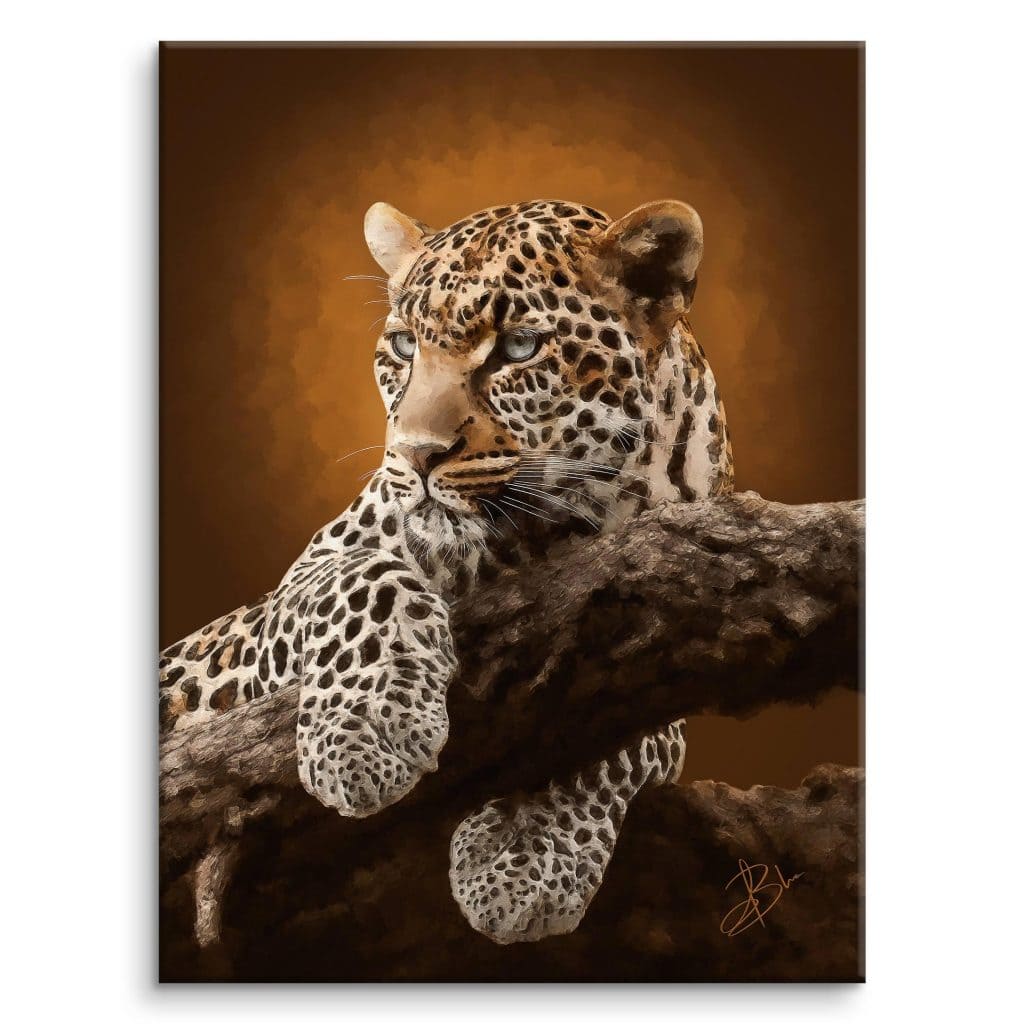
Nyota is the first work before which I stopped differently.
Not because it was perfect. That is not what I seek. But because, for the first time, I felt I had come close to what I had been searching for so long: the presence of an animal in its deepest, most silent, most untamable essence.
There was the gaze, the chiaroscuro… And that light which does not fall on the subject, but seems to come from within the shadows.
Nyota means “star” in Swahili. That name did not arrive by chance.
This painting was born during a particular period of my life. A time when a faithful presence helped me hold on, day after day. So naturally, something of that light stayed in the work.
It was through Nyota that I understood that digital painting was not there to replace traditional painting. It had its own way of revealing, of bringing forth material and emotion.
And sometimes, a single gaze is enough to understand that you have just found a language of your own.
If you would like to meet Nyota, it is this way.
When Digital Painting Takes Shape
A digital painting exists first in the light of a screen. It radiates. It is luminous by nature, because it comes from light. Then comes the moment when it must be given a material form.
The first print I received, on ordinary coated paper, devastated me. The colors were dull, the depth had vanished. Everything I had built over hours and hours no longer existed on that paper. I understood that day that the support is not a logistical detail. It is an artistic choice in its own right.
Then I received a print on Hahnemühle Fine Pearl paper.
A work. With a physical presence, a grain, a way of catching the ambient light differently depending on the angle of view. That is when I told myself we no longer simply had an image on paper. The work had truly found its body.
That moment confirmed for me that the choice of print support is not a technical detail. It is the last artistic decision in the life of a digital painting. If you want to understand how that transition happens: the papers, the color profiles, the formats, I explore it in detail in the article Which print support should you choose for a digital painting?
You Are Buying a Digital Painting, Not a File
If you are reading this article as a potential buyer, here is what to remember.
When you acquire one of my works, you are not buying a digital file. You are buying a digital oil painting printed on a carefully selected Fine Art support, accompanied by a certificate of authenticity. Each work is offered as a numbered limited edition or as an open edition, depending on the series. The work behind it is real. The hours, the aesthetic decisions, the technical mastery, the singular vision. All of that exists, even if you cannot see it directly.
What sets it apart from a reproduction or a decorative print is its origin. An artist, an intention, a singular gesture built over hours of work. The technique is digital. The painting is born from vision and the hand.
What Digital Painting Changes, in the End
Digital painting is not a new way of producing images. It is a way of painting.
It demands the same things as traditional painting: observing, choosing, building, doubting, starting again. It offers something different: a type of control and a freedom that some artists find in the resistance of canvas, and others in the stylus. The technique changes. The demand does not.
What I was trying to do for years in traditional work, I have been doing since I embraced this technique. Not because it is simpler. Because it is the only place where painting and my thinking meet without friction.
And when a digital oil painting then arrives on a Fine Art support, something definitive settles. It leaves the light of the screen, it takes shape on the paper, it becomes tangible. It finds its rightful presence.
That is what I try to give you with each work. Not an image. A presence.
Frequently asked questions about digital painting
How long has digital painting existed?
Older than it seems. People have been painting on screen since the 1980s, first on professional systems reserved for television, then with Photoshop from 1990 onward, when digital tools became widely available. A young discipline, but not born yesterday.
Is painting digitally faster than painting on canvas?
No, and it is a misunderstanding I come across often. The software does not paint for me. Every brushstroke, every shade of light, is a choice I make by hand, with the stylus, over many hours. Digital shifts the effort, it does not erase it.
Which software and tablets do you use to paint?
I paint in Photoshop, it has become my studio over the years. I switch between two Wacom tablets depending on the moment, the Intuos Pro to lay down the large masses with my eyes on the screen, and the Cintiq to draw straight onto the image when it is time for the details.
What are the advantages of digital painting over traditional painting?
Above all, the freedom of layers. If an area resists, I remove that single layer without touching the rest, something a dried oil painting does not allow, since you can then only paint over it. Add to that the absence of drying time and the freedom to paint almost anywhere. It is simply a different relationship with the gesture.
Is digital painting a true art form in its own right?
Yes, fully. It calls for the same knowledge as classical painting, light, values, composition. In 2012, David Hockney was exhibiting his iPad landscapes at the Royal Academy in London… Proof, if proof were needed, that a work holds in its gaze far more than in its tool.
Sources
- Adobe Inc., Photoshop History, adobe.com, 2024.
- Wacom Co., Ltd., Company History, wacom.com, 2023.
- Royal Academy of Arts, David Hockney RA: A Bigger Picture, exhibition, London, 2012.

